Skip to main content Scroll Top

How Artificial Intelligence Is Transforming the FMCG

Walk into any modern supermarket. Everything just feels… right. The shelves aren’t empty, the products you’re looking for are easy to find, and sometimes there’s even a discount on the exact thing you planned to buy. Billing doesn’t take long. The store looks clean and well arranged. Nothing feels out of place.
It almost feels natural, like things are just happening on their own.
But that’s not true. Behind it all, FMCG companies use AI.
FMCG means everyday items like food, drinks, soap, and cleaning products that sell fast and need constant restocking. AI helps companies decide what to stock, how much, where to send it, and when to offer discounts.
So when you walk into a store and find everything in place, it’s not by chance. It’s planned.
In this blog we’ll break it down for you. We’ll look at how AI is actually used in FMCG, why it matters so much, what kind of solutions companies are using, and what the future might look like.

What Is the FMCG and Why Is It So Complex?

Before getting into AI, you need to understand one thing — FMCG is not an easy industry to run. Products move fast, and decisions have to be even faster.

Here’s what makes running an FMCG business genuinely difficult:

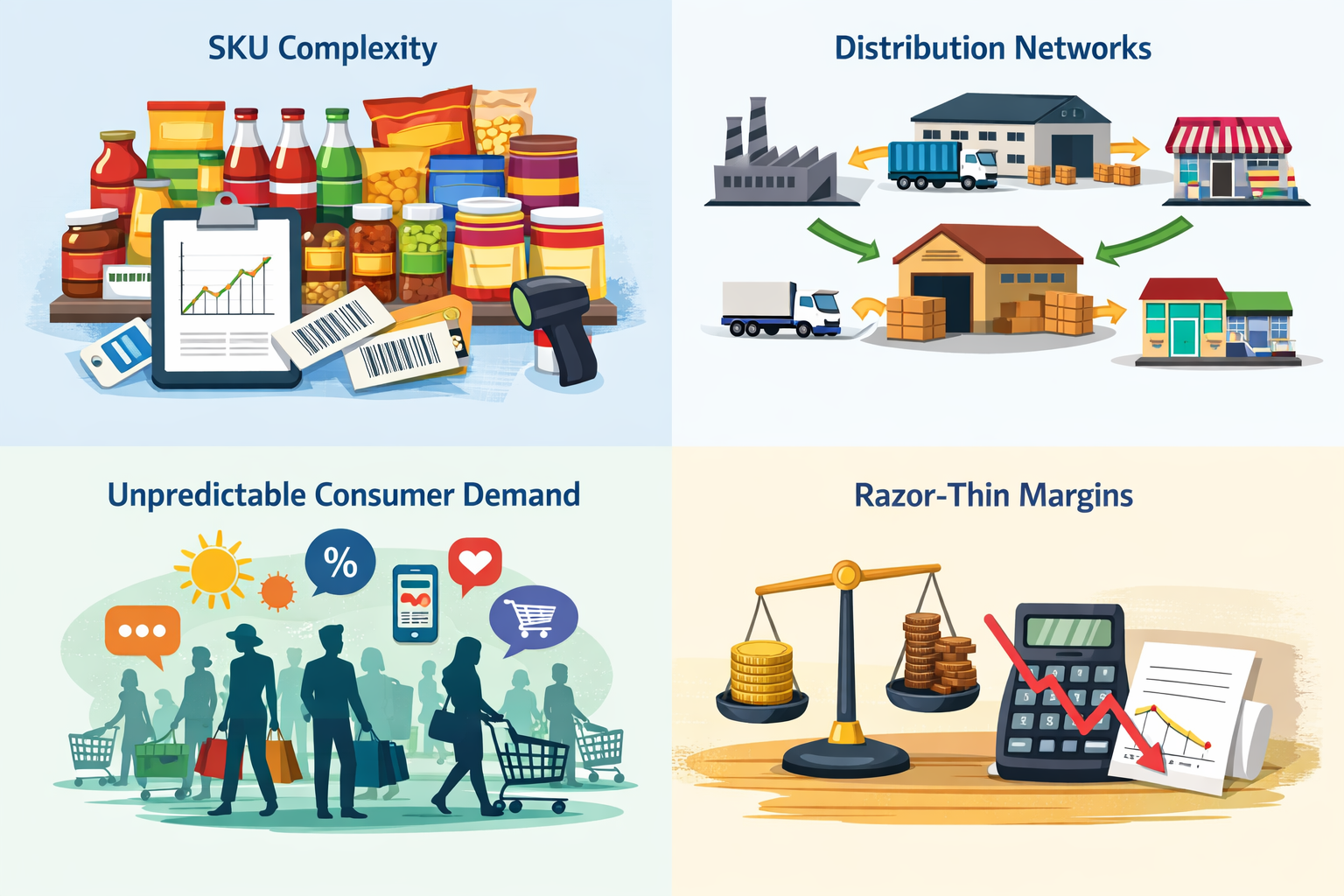
Massive SKU Complexity

A single brand can manage thousands of SKUs with different sizes, flavors, and packaging. Each one behaves differently in the market, which makes tracking and planning over specified.

Enormous Distribution Networks

Products don’t just go from factory to customer directly. They move through warehouses, distributors, and then to thousands of retail shops. One small delay can lead to empty shelves.

Unpredictable Consumer Demand

Customer behavior is unpredictable. People buy frequently, often without planning, based on trends, offers, weather, or even social media influence.

Razor-Thin Margins

Margins are very low in FMCG. Even a small mistake in stock, pricing, or delivery can reduce profits heavily.

That’s why AI in FMCG is no longer optional. Even a small improvement in forecasting or operations can create a big impact.
Razor-Thin Margins

AI-Powered Demand Forecasting & Inventory Management

Traditionally, demand forecasting was done by experienced sales managers using Excel spreadsheets, historical sales data, and gut instinct.
These methods work reasonably well for stable, predictable products. But the modern FMCG landscape is anything but predictable.

How AI Transforms Demand Forecasting

Modern AI demand forecasting in FMCG uses machine learning models to study large amounts of data and patterns. It can analyse many factors at once — far more than any human can handle — to make better predictions.

What AI analyses for demand prediction

The result is simple → AI demand forecasting reduces errors by 20–50%. That means less waste, fewer out-of-stock problems, and better use of money.
For large FMCG companies, this makes a huge difference.

AI in FMCG Supply Chain Optimization

The supply chain is the circulatory system of any FMCG business. It’s the entire journey a product takes from raw material sourcing → manufacturing → packaging → warehousing → transportation → retail shelf.
At each of these steps, inefficiencies cost money. And in a global business operating across thousands of routes and vendors, those inefficiencies add fast.
AI supply chain optimization in FMCG is now one of the biggest investment areas for major CPG (Consumer Packaged Goods) companies globally.
Here’s how it works in practice:
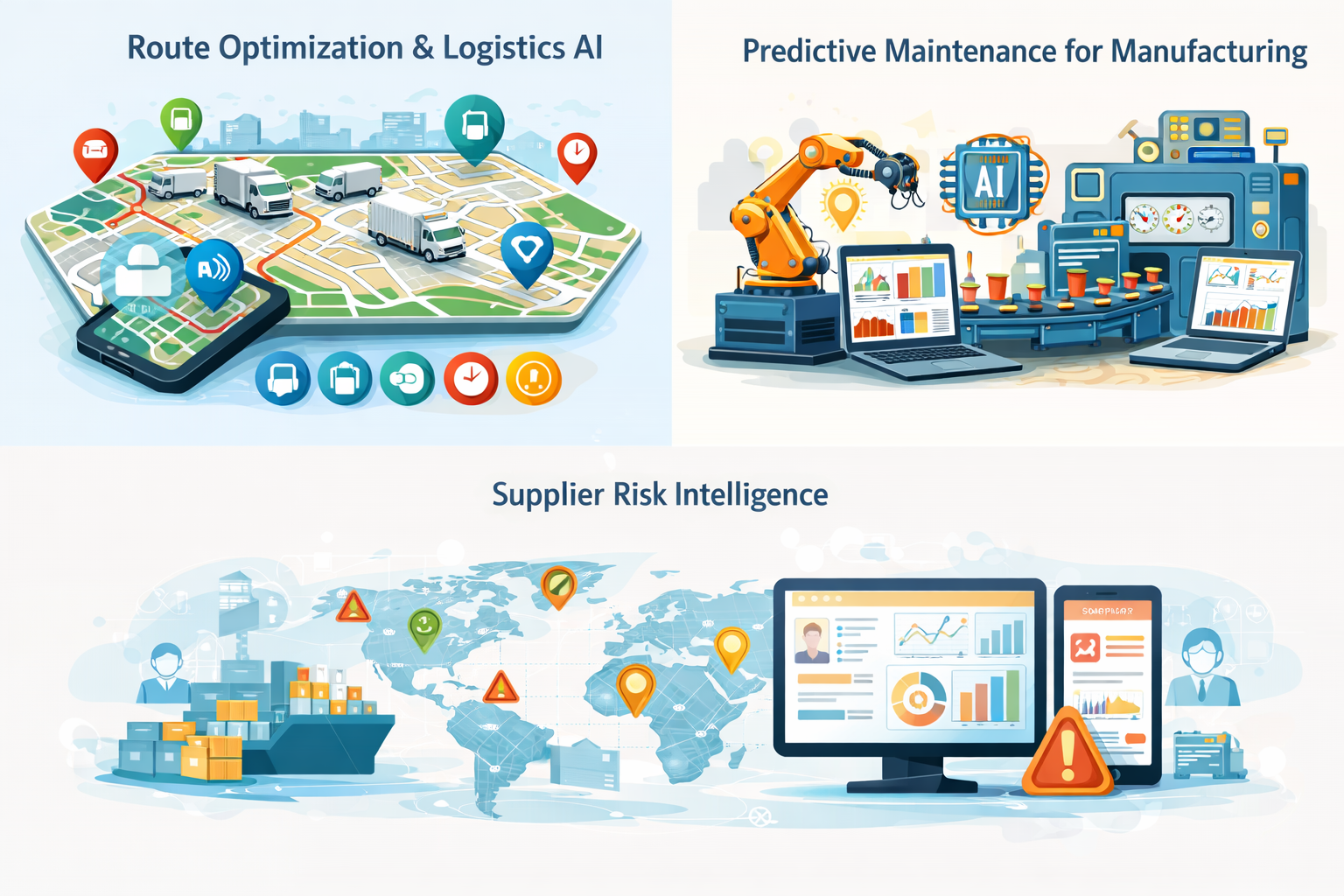
Route Optimization & Logistics AI
AI can plan the most efficient delivery routes for thousands of vehicles at once, considering traffic, fuel, vehicle capacity, delivery times, and driver shifts.
Predictive Maintenance for Manufacturing
AI with IoT sensors monitors machines for vibration, temperature, and pressure, spotting problems days in advance so fixes can be done before a breakdown.
Supplier Risk Intelligence
AI tracks suppliers, risks, port delays, and prices, giving FMCG teams early warnings. During COVID-19, companies using AI switched suppliers weeks faster than those using manual checks.

How TwinArcus Is Helping FMCG Brands Build Intelligent Systems

At TwinArcus we are at the forefront of delivering AI-powered supply chain intelligence system specifically tailored for FMCG and CPG businesses.
By combining deep-tech expertise with domain knowledge of how fast-moving goods actually flow through complex distribution networks, TwinArcus helps brands move from reactive problem-solving to proactive, data-driven decision-making — reducing disruptions, cutting costs, and improving service levels across the board.
our approach emphasizes making AI solutions practical and accessible, not just theoretically impressive.

Hyper-Personalisation & Consumer Behavior Intelligence

Think about how Spotify seems to know exactly what song you want to hear next. It studies your habits and builds a personal profile from thousands of data points. FMCG companies are doing something similar with their customers.
AI in FMCG doesn’t just suggest products online. It helps companies understand what consumers want, which shapes product development, packaging, marketing strategies, and even which flavors or versions of a product to launch in specific regions.
This kind of intelligence lets brands connect with customers in a more personal and effective way.
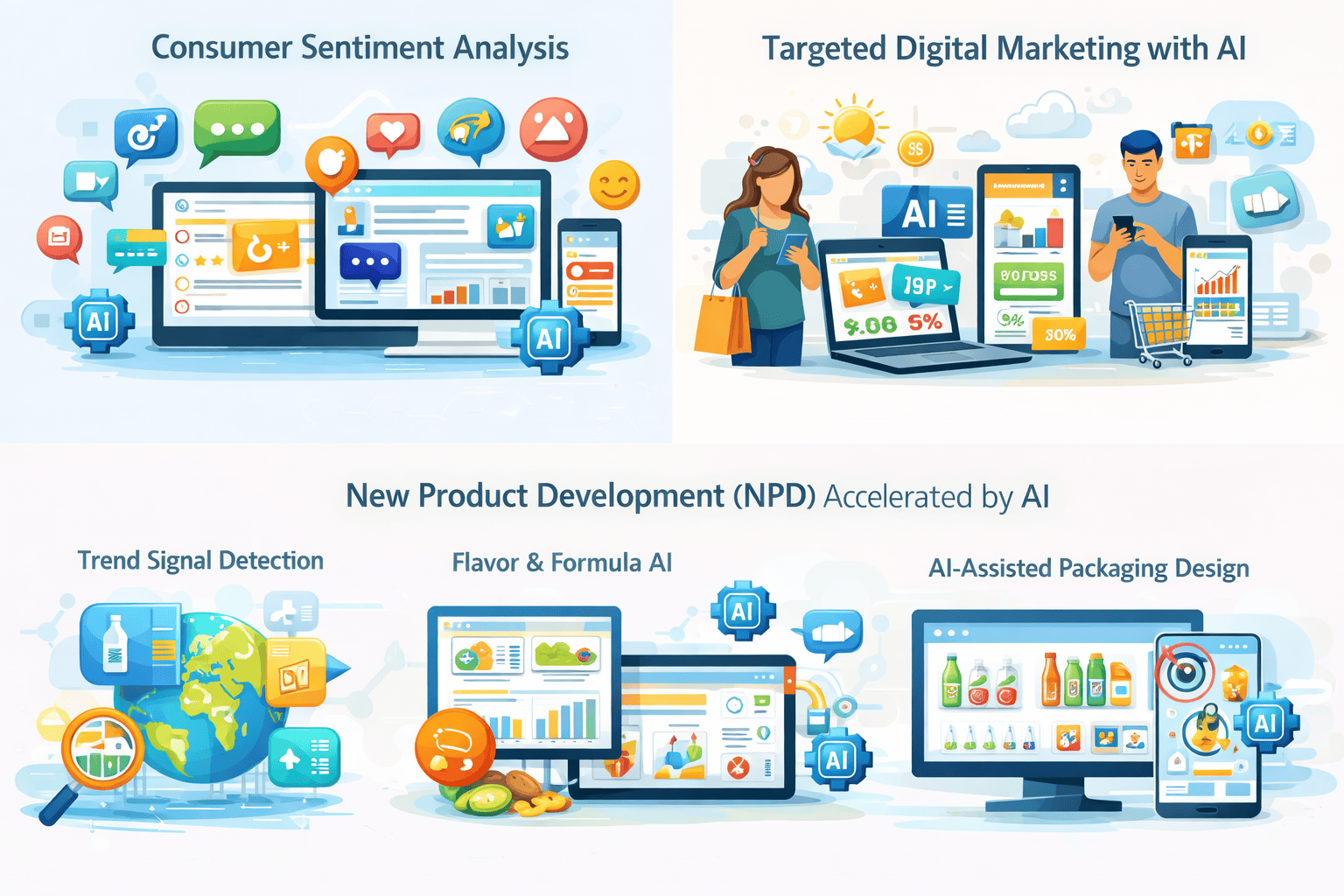
Consumer Sentiment Analysis
AI tools read reviews, social media, blogs, and forums to understand how consumers really feel about products. This sentiment analysis gives FMCG brands real-time insights into satisfaction, brand health, and unmet customer needs.
Targeted Digital Marketing with AI
AI helps FMCG brands show the right ads to the right people at the right time, using browsing history, purchases, and even local weather.
New Product Development (NPD) Accelerated by AI
Traditionally, developing a new FMCG product took 12–24 months from concept to shelf. AI is compressing this timeline significantly. Here’s how the new AI-driven NPD process works:

Integrate & Automate

AI scans global food, beauty, and wellness trends across multiple markets to spot rising ingredients or formats before they become popular.

AI suggests ingredient combinations and formulations based on consumer preferences, cutting down R&D trial-and-error.

AI tests packaging colors, layouts, and graphics using eye-tracking data to predict which designs will attract customers on shelves.
Hyper-Personalisation & Consumer Behavior Intelligence

“AI doesn’t replace the creativity and intuition of FMCG professionals — it amplifies them, giving every brand manager and supply chain head a superpower: the ability to see patterns in data that no human eye could possibly detect at scale.”

Dynamic Pricing & Revenue Management with AI

Pricing in FMCG is tricky. Brands need to balance customer demand, competitor prices, promotions, distributor margins, and production costs. Get it wrong, and you lose sales or profit.
AI-powered dynamic pricing allows FMCG brands and retailers to make smarter, faster, and more granular pricing decisions.

Here’s what that looks like in practice:

Price Elasticity Modeling

Studies past sales at different prices to find how much demand changes with price. This helps brands pick the best price to maximize sales, revenue, or profit.

Promotion Effectiveness
Measures how well promotions actually work, accounting for retailer stock-ups, product cannibalization, and effects on related products, so companies know which deals really boost revenue.

Why This Matters

“Around 20–30% of FMCG promotions are unprofitable. AI helps brands cut these losses and focus on promotions that truly boost profit.”

AI-Powered Quality Control & Food Safety

For FMCG brands, product quality is critical – one failure can harm reputation, trigger recalls, and risk consumer safety. Traditional inspections could only check a few items on fast-moving lines.
AI is now transforming quality control, making it faster and more thorough.
Computer Vision Quality Inspection
AI with high-speed cameras can check every product on the production line, not just samples. It spots defects like misaligned labels, wrong fill levels, packaging issues, color problems, or contamination all in real time.
For example, a biscuit factory can automatically reject misshapen or under-baked biscuits that human inspectors might miss.

Blockchain + AI for Traceability

When a food safety issue happens, companies need to know which batch is affected and where it went. AI combined with blockchain lets them trace every product from manufacture to the store. What once took days can now be done in minutes, cutting recall costs and risks.

TwinArcus: Connecting AI Solutions to Real FMCG Business Problems

What separates genuinely impactful AI implementation from expensive failed experiments is domain expertise — knowing exactly which AI solution maps to which business problem.
This is were TwinArcus bring enormous value to FMCG companies navigating the AI landscape.
Rather than applying generic technology, TwinArcus works to understand the specific commercial realities of FMCG – the pressure of thin margins, the complexity of trade channels in markets, the speed at which shelf execution needs to happen and then designs AI solutions that deliver tangible, measurable ROI against those specific challenges.
For FMCG businesses exploring their AI transformation journey, a partner with this level of sector-specific understanding can make the difference between a successful deployment and a costly disappointment.

The Future of AI in FMCG: What's Coming Next?

We’re genuinely still in the early innings of the AI revolution in FMCG. The technologies being deployed today are impressive, but what’s coming over the next 3–7 years will be even more profound.
One of the most exciting frontiers is Agentic AI. Agentic AI goes beyond analysis and takes action on its own. In FMCG, it can spot a demand spike, check inventory, place orders, assign deliveries, and notify the sales team automatically. This all happens without any human coordination.
Whether you’re running a large national FMCG brand or a regional food company, the question of “where do we start with AI?” can feel overwhelming. Here’s a practical, honest framework:

How Should FMCG Companies Start Their AI Journey?

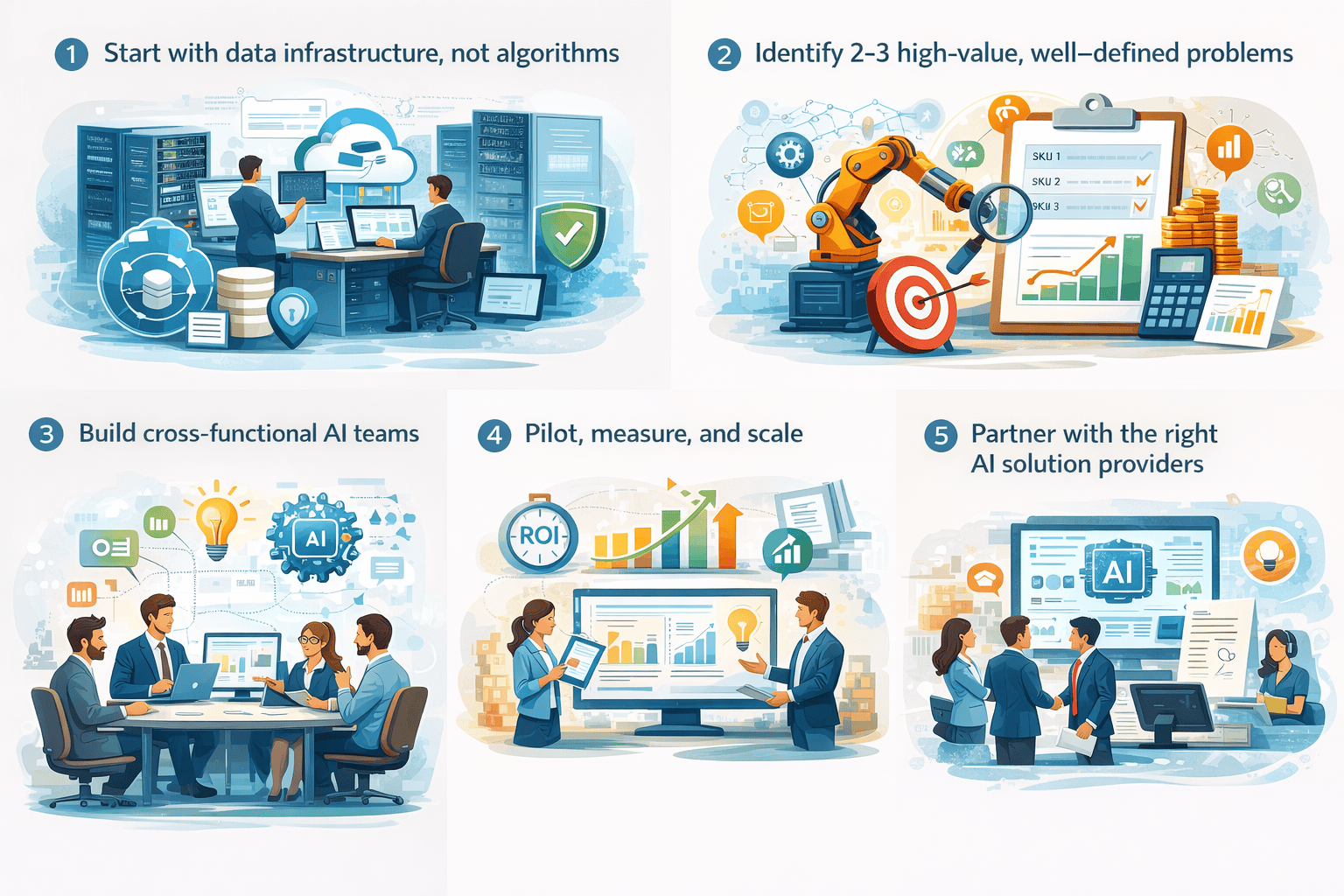
1. Start with data infrastructure, not algorithms

Before you can build AI, you need clean, unified data. Audit what data you have, where it lives, and how reliable it is. Investing in data integration and data quality is unglamorously but foundational.

2. Identify 2–3 high-value, well-defined problems

Don’t try to “implement AI across the business” — that’s too vague. Instead, pick specific problems with clear KPIs: “reduce forecast error for our top 100 SKUs by 20%” or “automate shelf compliance auditing in 500 key stores.”

3. Build cross-functional AI teams

Successful AI projects need data scientists AND domain experts who deeply understand FMCG operations. If your data team doesn’t understand how FMCG distribution works, their models will miss crucial business context.
4. Pilot, measure, and scale
Run a focused pilot with measurable outcomes. If it delivers ROI, scale it. If it doesn’t, learn from it and adjust. Avoid multi-year, big-bang AI transformation programs that don’t deliver value until the very end.
5. Partner with the right AI solution providers
Unless you have a world-class internal AI team, working with specialist partners who understand both AI technology and the FMCG industry will dramatically accelerate your journey and reduce costly mistakes
The Bottom Line: AI Is No Longer Optional for FMCG
If there’s one message to take away from this deep dive, it’s this: AI in FMCG is not a futuristic concept — it’s happening right now, at scale, across the world’s biggest consumer goods companies. And the gap between companies that adopt it intelligently and those that don’t is widening every quarter.
From AI demand forecasting that keeps shelves stocked without waste, to machine learning supply chain optimization that routes deliveries with surgical precision, to computer vision quality control that catches defects no human eye would spot — the applications are practical, proven, and delivering real commercial value.
For FMCG companies globally, the question is no longer “should we invest in AI?” It’s “where should we start, and how do we do it right?”
The companies that answer that question well — choosing the right problems, building the right data foundations, and working with the right partners — will be the ones writing the next chapter of FMCG success.
The future of fast-moving consumer goods is, in the most literal sense, intelligently automated. And for those willing to embrace it thoughtfully, the rewards are enormous.
Tell Us What You Want to Improve in Your FMCG Operations
The challenges of managing inventory, predicting demand, tracking shelf availability, or planning promotions vary from one company to another. Instead of offering a generic solution, we work with brands to understand their specific pain points and goals.
Share a bit about your current operations and the areas you want to improve, and we can suggest AI solutions that will have the most impact on your efficiency, sales, and customer satisfaction.
We're Here to Answer All Your Questions
Shap divider left
Enterprise AI
Scalable technology solutions for secure growth & innovation
Shap divider right
Index