
Skip to main content Scroll Top

How Artificial Intelligence is Quietly Revolutionizing Healthcare — And Why It Matters to Everyone

From spotting cancer on a scan before a doctor can, to discovering life-saving drugs in months instead of decades, AI in healthcare is no longer a futuristic idea. It’s happening right now, in hospitals, labs, and clinics around the world.
Think about the last time you went to a doctor. You explained what you’re feeling, they asked a few questions, maybe sent you for a test, and then gave you an answer based on their experience. That whole flow? It hasn’t really changed for years.
But quietly, things are shifting. Artificial intelligence in healthcare is already reading X-rays faster, spotting risks earlier than we can, and even helping doctors choose treatments that actually fit you, not just the average patient. This isn’t some future idea. It’s already happening… just not loud enough for everyone to notice yet.

What Does AI Actually Mean in Healthcare?

Before we go deeper, let’s get one thing clear especially if this is new to you. When we say AI in healthcare, we’re just talking about systems that can handle tasks doctors usually do with experience and judgment. That could be reading scans, analyzing patient data, suggesting treatments, answering basic queries, or even helping researchers find new drugs. Nothing fancy, just smarter tools doing real medical work.
There are several types of AI technologies being used in healthcare today:
Machine Learning (ML)

Systems that learn from large amounts of patient data and improve their predictions over time — without being explicitly programmed for every scenario.

Computer Vision

AI that can “see” and interpret medical images – X-rays, MRIs, CT scans, pathology slides often with superhuman accuracy.
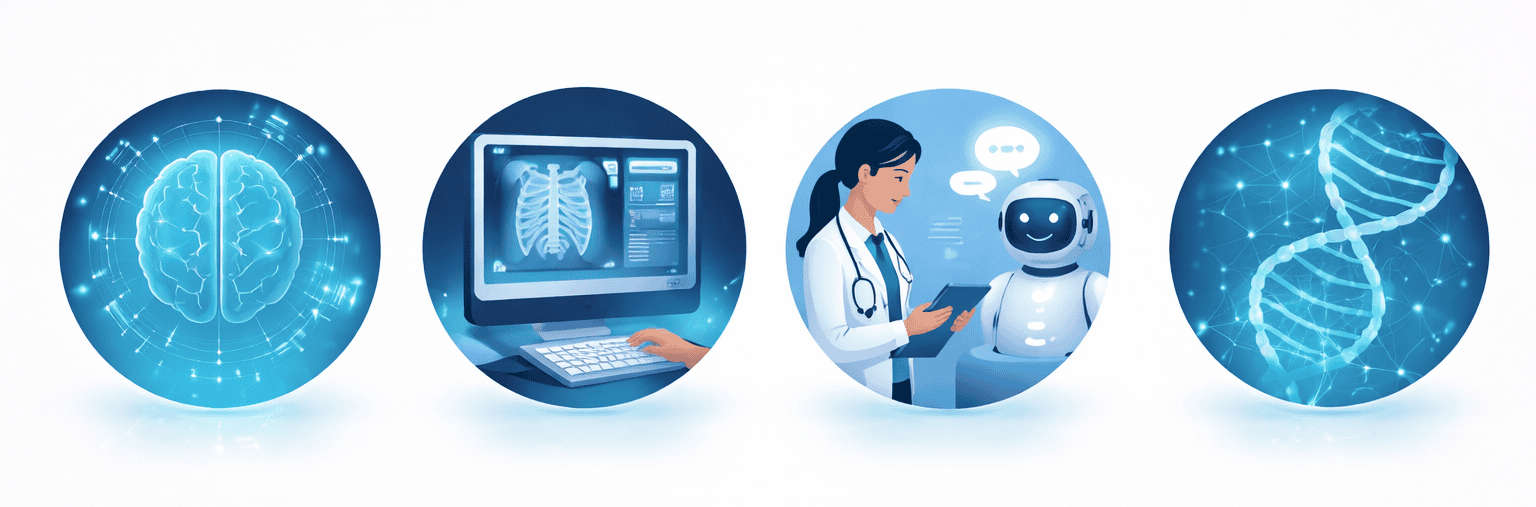
Natural Language Processing (NLP)
AI that understands and generates human language – used for medical transcription, clinical notes, and patient-facing chatbots.
Deep Learning
A more advanced form of ML inspired by the human brain. It is used in genomics, protein folding, and complex pattern recognition in clinical data.
Together, these AI technologies form the backbone of what is now widely called the AI implementation in healthcare movement – a structured effort by hospitals, pharmaceutical companies, health tech startups, and governments to embed intelligent systems into every layer of care delivery.
What Does AI Actually Mean in Healthcare

Real-World AI Applications in Healthcare

Let’s move past theory and look at where AI in healthcare is actually making a real difference today, these aren’t experiments, but systems already in use, improving patient outcomes.

1. Medical Imaging and Diagnostics

This is arguably the most mature and impactful area of AI in the healthcare industry today. AI models trained on millions of labelled medical images can now detect conditions in scans with accuracy that rivals and sometimes exceeds that of experienced radiologists.
Tools like those from DeepMind can detect multiple eye diseases, while AI in cancer screening helps reduce missed cases and false alarms. It’s already helping doctors make faster and more accurate decisions.
2. Predictive Analytics and Early Warning Systems
One of the biggest strengths of artificial intelligence in healthcare is predicting problems before they happen. AI tracks patient data in real time and can spot early signs of serious issues like sepsis or organ failure.
It also helps hospitals identify patients who might be readmitted, so doctors can take action early and improve outcomes.
3. Drug Discovery and Development
Traditionally, developing a new drug takes 10–15 years and costs over $2 billion. Most drug candidates fail in late-stage trials, a hugely expensive and demoralizing process. AI in life sciences is fundamentally changing this.

AI platforms can screen billions of molecular compounds in silico (virtually, on computers) to identify those most likely to be effective against a specific disease target — in days or weeks, not years.

4. Personalized Medicine and Genomics

Not everyone responds to treatment the same way, and that’s where AI-driven personalized medicine is making a real difference.
By analyzing genetic data and patient history, AI helps doctors choose treatments that are more likely to work and avoid ones that may cause side effects, reducing trial and error, especially in areas like cancer and mental health.
5. AI-Powered Virtual Health Assistants and Chatbots
Not every healthcare need requires a hospital visit, sometimes people just need clear guidance. That’s where AI-powered health assistants are making a difference.
They help users understand symptoms, decide when to see a doctor, and manage ongoing conditions. These tools also track patient data, send reminders, and provide support for chronic diseases, while handling large volumes of queries and reducing pressure on healthcare systems.

6. Administrative Automation and Clinical Workflow
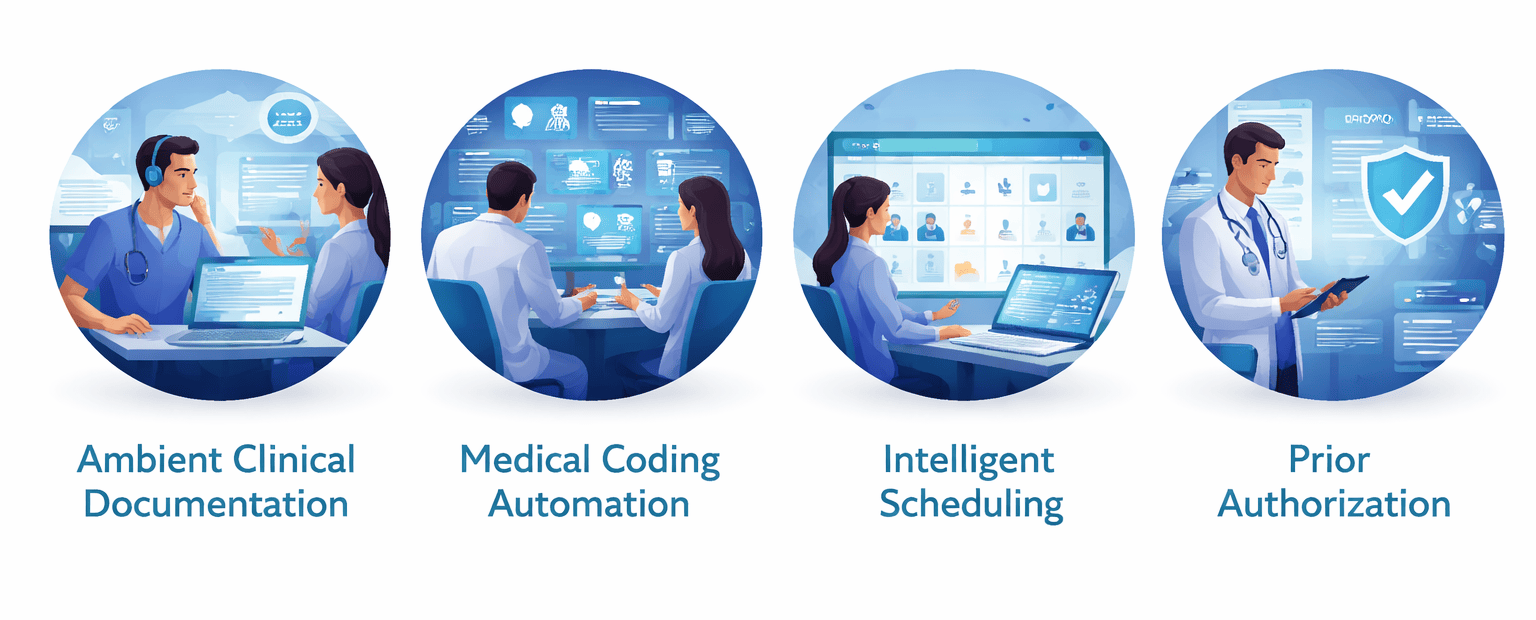
Doctors in many countries spend nearly 50% of their working day on administrative tasks, documentation, coding, prior authorizations, scheduling. This time taken away from patients represents one of the most significant inefficiencies in modern healthcare. AI implementation in healthcare administration is tackling this head-on.
Real-World AI Applications in Healthcare

Healthcare Organizations Navigate the AI Revolution

At TwinArcus, we work with healthcare providers, life sciences companies, and health tech startups to design, build, and implement AI-powered solutions that are practical, ethical, and measurably impactful. Whether you’re exploring your first AI use case or scaling an existing initiative, our team has the deep domain expertise to guide you every step of the way.

What Does the Future of AI in Healthcare Look Like?

The trajectory is clear: AI in the healthcare industry will become increasingly pervasive, increasingly capable, and increasingly central to how care is delivered. Here are some of the most significant developments to watch in the coming years.

“The question is no longer whether AI will transform healthcare. The question is how quickly organizations act — and whether they do so thoughtfully, safely, and equitably.”

How to Get Started with AI in Your Healthcare Organization

If you’re a healthcare executive, clinician, or decision-maker reading this and wondering where to begin — here’s a practical framework for approaching AI adoption in healthcare in a structured, risk-conscious way.

Ready to Build AI-Powered Healthcare Solutions That Actually Work?

At TwinArcus, we’ve guided organizations through every stage of the AI adoption journey from initial strategy and use-case prioritization, through to model development, clinical validation, and scaled deployment.

Our team combines deep healthcare domain knowledge with cutting-edge AI engineering to deliver solutions that are not only technically excellent, but clinically meaningful and ethically grounded.

→ Let’s build the future of care together.
We're Here to Answer All Your Questions
Shap divider left
Enterprise AI
Scalable technology solutions for secure growth & innovation
Shap divider right
Index