
Skip to main content Scroll Top

AI in Banking: Transforming the Future of Financial Services

What Is AI in Banking And Why Should You Care?

At its core, AI in banking simply means using technologies like machine learning, natural language processing (NLP), robotic process automation (RPA), and predictive analytics to make banking smarter. These tools help banks automate decisions, understand customers better, detect fraud, and improve how their operations run.

If you’re new to this, think of it like this: traditional banking mostly depended on people and fixed rules. A loan officer would sit and review your application manually. A compliance team would go through transactions to spot anything suspicious. Customer support teams had to handle every single call.

Now, things are changing.
With AI, banks systems learn from huge amounts of data and make decisions much faster and, in many cases, more accurately. What used to take days, like loan approvals, can now happen in seconds.
This doesn’t mean people are being completely replaced. It’s more about making the whole system work better faster processes, fewer errors, and better access for customers.

That’s exactly why AI in banking and financial services is becoming such an important and widely discussed topic today.

“Artificial intelligence in banking is not a future trend — it is the present infrastructure. Every major bank on Earth is either deploying AI or racing to catch up.”

The Building Blocks: Core AI Technologies Powering Finance
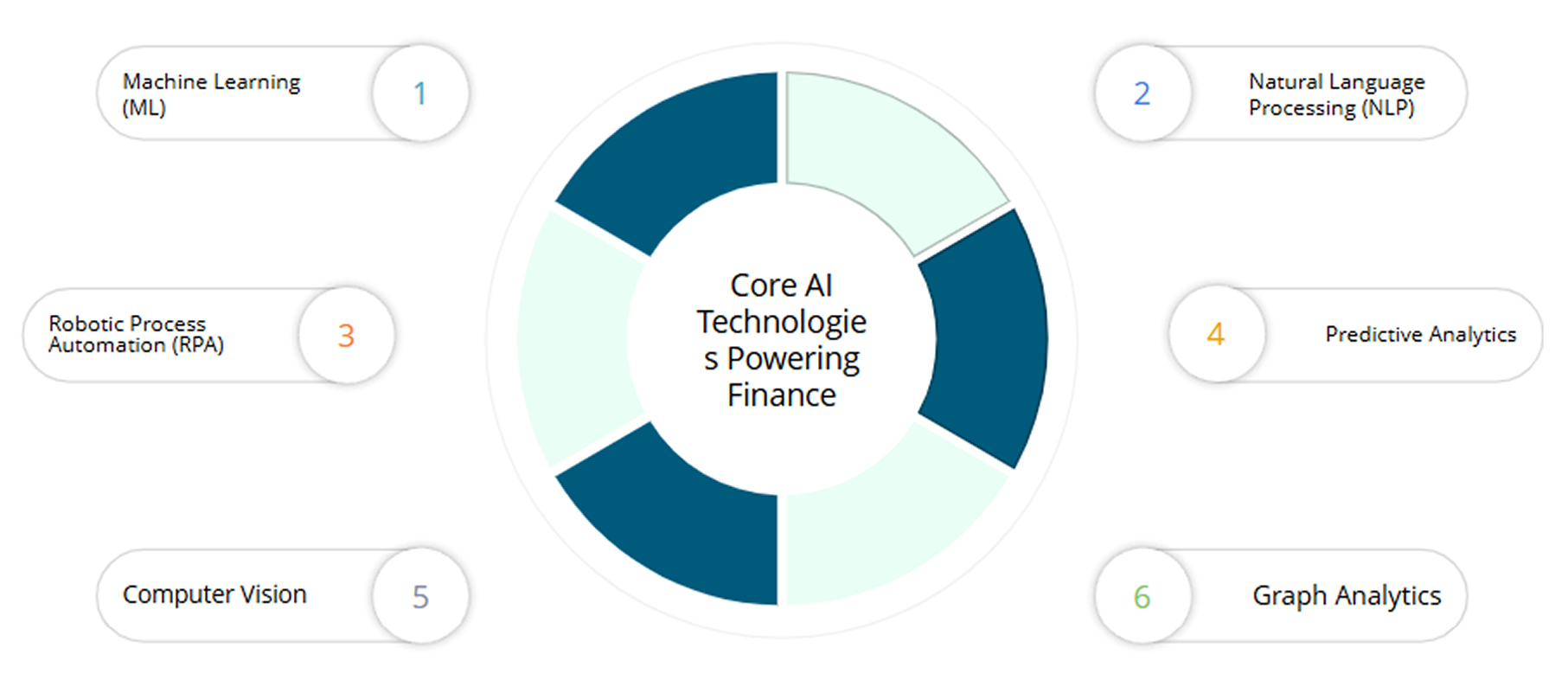
Before diving into specific applications, it’s worth understanding the key technologies that make AI-powered banking possible.
The Building Blocks Core AI Technologies Powering Finance

Machine Learning (ML)

Algorithms that learn patterns from historical data without being explicitly programmed. Banks use ML to predict credit risk, detect fraud, and forecast market movements.

Natural Language Processing (NLP)

Enables computers to understand and respond to human language. Powers chatbots, voice assistants, and automated document review in financial services.

Robotic Process Automation (RPA)
Software robots that perform repetitive, rule-based tasks – data entry, form processing, report generation at machine speed, 24/7 without errors.
Predictive Analytics
Uses statistical models and historical data to forecast future events like which customers are likely to default, or what market conditions might look like next quarter.
Computer Vision
AI that interprets images and video. Banks use it for cheque processing, KYC document verification, and even behavioral biometrics for authentication.

Graph Analytics

Maps complex relationship networks between accounts, entities, and transactions. Critical for catching money laundering rings and financial crime networks.

How AI Is Actually Being Implemented in Banking: 8 Real-World Applications

Here are the most important ways AI in financial services is being deployed right now, explained simply and clearly.

1. Fraud Detection and Prevention

Financial fraud costs trillions every year. Earlier, banks used simple rules like flagging high-value or unusual transactions but fraudsters easily bypassed them.
Now, AI in banking uses machine learning to study millions of transactions and detect hidden patterns. Instead of just checking the amount, AI looks at behavior and identifies fraud more accurately.
This is why fraud detection is one of the biggest advantages of AI in banking and financial services.

In fraud detection, AI doesn’t just look at the transaction amount. It considers:

  1. Your typical spending location, time of day, and merchant category.
  2. How you normally type, swipe, or hold your phone (behavioral biometrics).
  3. The device fingerprint, IP address, and network you’re connecting from.
  4. Velocity patterns, how quickly multiple transactions are occurring.
  5. Social graph connections between accounts flagged for suspicious activity.

2. AI Chatbots and Virtual Financial Assistants

AI chatbots in banking have fundamentally changed customer service in the financial sector. These aren’t your old-school, frustrating “press 1 for account balance” systems.
Modern banking chatbots powered by large language models (LLMs) and NLP can:
Handle complex multi-step conversations, understand intent even when customers phrase things oddly, look up real-time account information, initiate transactions, escalate to human agents with context already loaded, and do all of this in multiple languages, 24 hours a day, 7 days a week.
Hundreds of smaller banks worldwide have deployed similar AI-powered customer service systems. A well-deployed banking chatbot can handle 70–80% of routine customer queries without human involvement, dramatically reducing operational costs while actually improving customer satisfaction scores because customers get instant answers, any time.
3. Credit Scoring and AI-Powered Loan Decisions
Traditional credit scoring like CIBIL or FICO mainly looks at past data, which often leaves out young professionals, self-employed individuals, and those with thin credit files are often denied loans despite being perfectly creditworthy.
AI-based credit scoring changes this by looking at more real-world signals such as payment behavior, income patterns, and other financial activities. This gives a more accurate picture of a person’s ability to repay.
As a result, banks can make better loan decisions and offer credit to more people. This is why it’s considered one of the most impactful uses of AI in financial services, especially in growing markets like India and Southeast Asia.
4. Personalized Financial Advice and Wealth Management (Robo-Advisors)
Earlier, investment advice was only for wealthy people who could afford expensive financial advisors. Now, AI-powered robo-advisors have made this accessible to everyone.
These systems analyze your risk level, income, and financial goals to create a suitable investment plan. They also adjust your portfolio automatically based on market changes and help optimize taxes.
At the same time, AI is enabling hyper-personalized banking experiences. Your banking app can track your spending, warn you about overspending, and suggest better saving or investment options based on your behavior.
All of this comes under personalized financial services, where banks use AI to give smarter, more relevant suggestions. This level of personalization was not possible before AI.
5. Anti-Money Laundering (AML) and Regulatory Compliance
Anti-money laundering compliance is one of the biggest challenges in banking today, costing billions every year. Traditional AML systems mostly rely on fixed rules, which often create too many false alerts. Because of this, compliance teams end up spending a lot of time checking normal transactions, and sometimes real suspicious activities get missed.
AI-powered AML solutions make a real difference. Instead of depending only on rules, AI studies large amounts of transaction data and identifies unusual patterns more accurately. It can connect relationships between accounts, users, and regions, helping banks detect complex money laundering activities that are hard to find manually.
In the end, AI helps reduce false alerts, saves time, and improves how banks manage compliance, making the entire system more efficient and reliable.
6. Algorithmic Trading and Market Intelligence
Algorithmic trading uses AI to analyze large amounts of market data and make fast trading decisions. These systems can process data like market trends, news, and economic signals in real time.
Modern systems powered by Deep learning models go even further by analyzing unstructured data such as reports, transcripts, and other complex information that humans may miss. This helps in identifying better trading opportunities.
Today, a large share of trading in major markets is driven by AI. This shows why AI in investment banking has become crucial for improving market efficiency, speed, and decision-making.
7. KYC Automation and Digital Onboarding
KYC is required for banks to verify customer identity, but traditional processes are slow and manual, often taking days to complete.
With AI-powered KYC automation, banks can verify documents instantly using technologies like computer vision, facial recognition, and NLP. This allows customers to open accounts quickly from their phones without visiting a branch.
As a result, onboarding becomes faster, more secure, and much more efficient for both banks and customers.
8. Predictive Risk Management and Stress Testing
After the 2008 financial crisis, banks were required to run stress tests to ensure they can handle major economic downturns. These tests are complex, as they involve analyzing multiple risk factors across loans, investments, and market conditions.
With AI-driven risk management platforms, banks can perform these simulations faster and more accurately, and even monitor risks in real time.
This is where Predictive risk analytics plays a key role, helping banks identify potential threats early and take action before they turn into serious problems.

AI in Retail Banking vs. Investment Banking vs. Insurance: The Differences

It’s important to note that AI in financial services looks quite different depending on the specific sector. Here’s a useful overview:

Sector Primary AI Applications Maturity Level
Retail Banking
Chatbots, fraud detection, personalized offers, credit scoring
High
Investment Banking
Algorithmic trading, risk modeling, M&A research automation
High
Wealth Management
Robo-advisors, portfolio optimization, tax efficiency
Medium
Insurance (InsurTech)
Claims automation, underwriting AI, fraud detection
Medium
Payments & FinTech
Real-time fraud scoring, AML, smart reconciliation
High
Microfinance / Lending
Alternative credit scoring, digital onboarding
Growing

The Road Ahead: What's Next for AI in Banking?
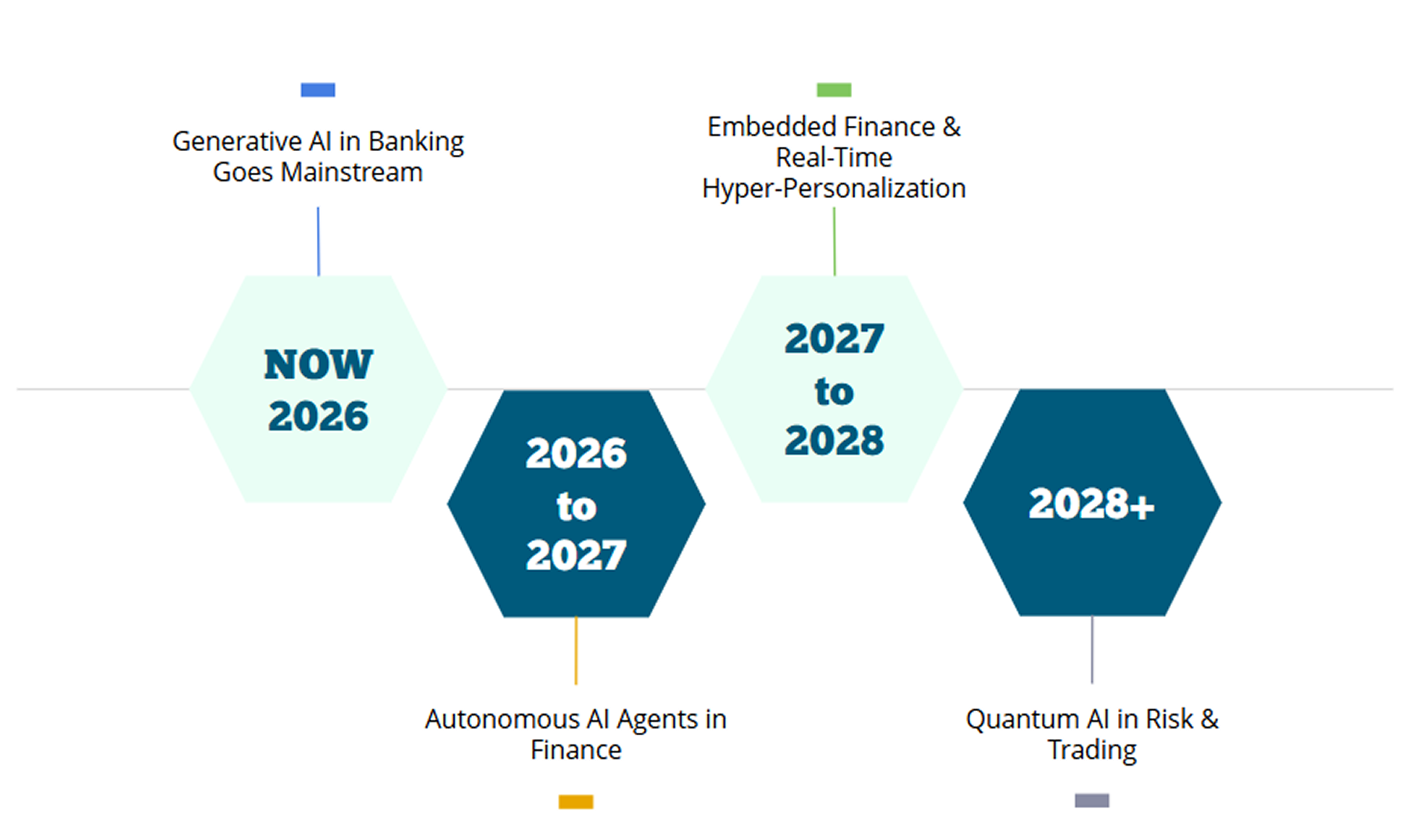
The pace of innovation in AI and banking shows no signs of slowing. Here’s a look at what the next few years are likely to bring:

TwinArcus on the Practical Path to AI Adoption in Banking

TwinArcus helps banks move towards AI with a clear, practical approach focused on real results, not just theory. They make AI adoption simple, scalable, and aligned with business goals.
“The banks that will define the next decade are not those with the most branches or the largest balance sheets. They are those that best harness the power of data and artificial intelligence.”

Final Thoughts

Artificial intelligence in banking and financial services is one of the biggest changes the industry has ever seen. It is transforming how people borrow, save, invest, and manage money.
For customers, it means faster, smarter, and more personalized services. For banks, it helps improve efficiency, reduce risk, and serve more people.
However, successful adoption depends on using AI responsibly, with the right focus on security, fairness, and trust.
We're Here to Answer All Your Questions
Shap divider left
Enterprise AI
Scalable technology solutions for secure growth & innovation
Shap divider right
Index